
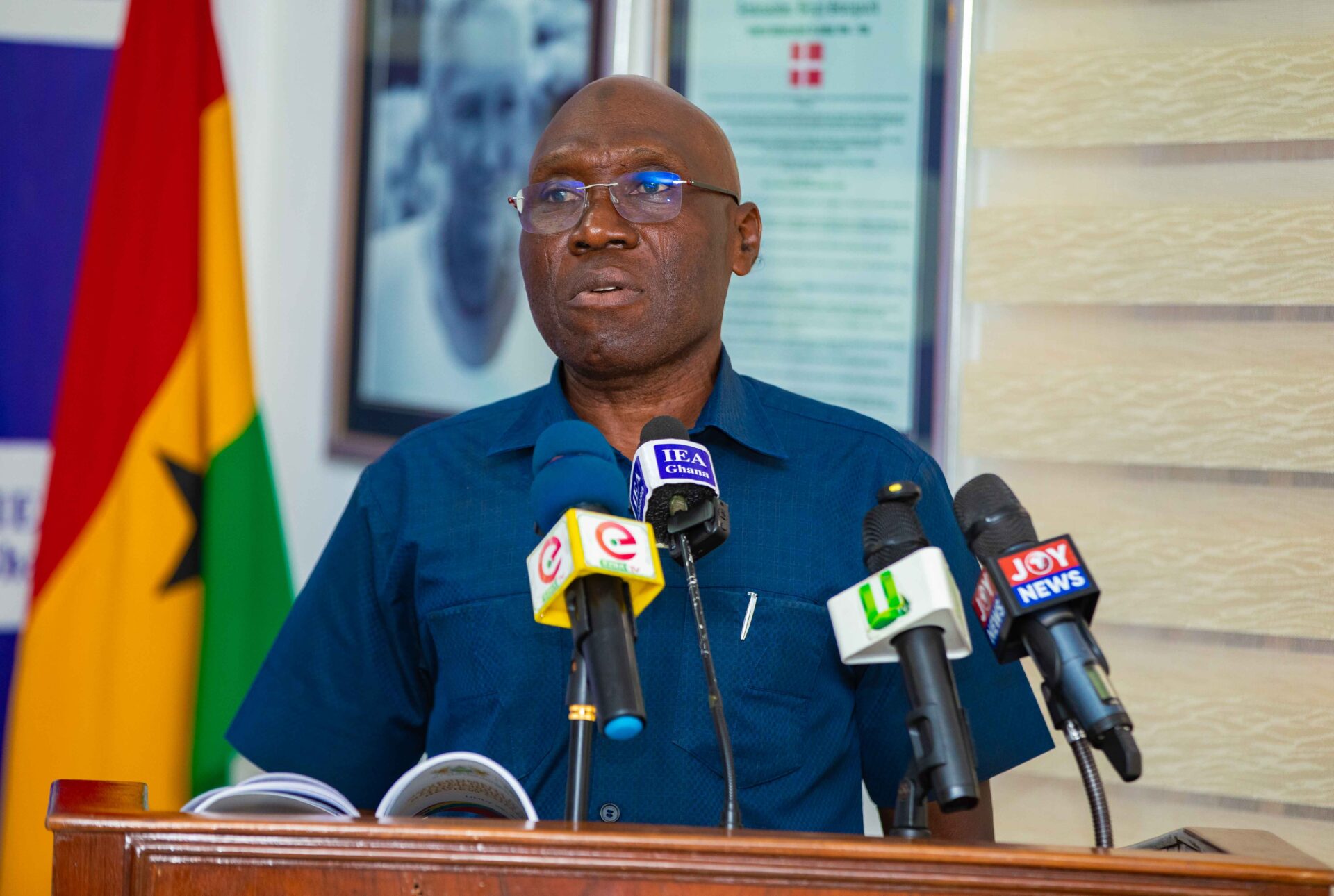
Former Lands and Natural Resources Minister Inusah Fuseini and former Deputy Minister George Mireku Duker contribute to national dialogue on resource ownership, accountability, environmental protection and sustainable development.
The Institute of Economic Affairs (IEA Ghana), on Tuesday, 20 October 2026, convened another edition of its Views and Reflections Programme at the IEA Dialogue Centre in Accra, focusing on the constitutional governance of Ghana’s lands and natural resources.
The engagement formed part of the Institute’s continuing series of national dialogues examining the report of the Constitution Review Committee, chaired by Professor H. Kwasi Prempeh, and the Government’s position on the proposed amendments to Ghana’s 1992 Constitution.
The session brought together two distinguished personalities with extensive experience in natural resource governance, public administration and parliamentary affairs: Hon. Inusah Fuseini, former Minister for Lands and Natural Resources and former Member of Parliament for Tamale Central, and Hon. George Mireku Duker, former Deputy Minister for Lands and Natural Resources and former Member of Parliament for Tarkwa-Nsuaem.
Their participation provided an opportunity to examine the legal, institutional and economic implications of the proposed constitutional reforms, particularly their significance for Ghana’s ability to exercise effective control over its natural resources and secure greater benefits from their exploitation.
The dialogue came at an important moment in Ghana’s constitutional reform process, as the country considers fundamental questions about the ownership, management, protection and distribution of benefits arising from its considerable natural resource endowment.
Natural Resources and Ghana’s Development Aspirations
Ghana possesses substantial deposits of gold, bauxite, manganese and other minerals, alongside petroleum, natural gas, forests, water bodies, fertile agricultural lands and marine resources. These assets represent important sources of public revenue, employment, investment and opportunities for industrial development.
Notwithstanding this considerable endowment, questions persist about whether the country has secured sufficient economic and developmental benefits from the exploitation of its natural resources.
These concerns extend beyond the revenues received by the State. They encompass the structure of natural resource agreements, the extent of national participation and ownership, environmental sustainability, the distribution of benefits to resource-producing communities and the ability of successive governments to manage these assets in the long-term national interest.
The constitutional review process therefore presents an opportunity to reconsider whether Ghana’s existing governance framework provides sufficiently strong safeguards for the management of natural resources.
At the centre of the debate is a fundamental question: How can Ghana ensure that its natural resources are managed as a national inheritance, with their benefits accruing equitably to present and future generations?
Examining the Prempeh Committee’s Recommendations
The Constitution Review Committee proposed significant changes to the constitutional provisions governing public lands and natural resources.
Among its central recommendations is a proposal to amend Article 257 of the Constitution to vest public lands and natural resources directly in the people of Ghana, with the State exercising trusteeship responsibilities on their behalf.
The Committee also proposed the introduction of express constitutional principles governing natural resources, including public trusteeship, sustainability, transparency, accountability, equitable benefit-sharing, environmental stewardship and intergenerational equity.
These proposals seek to establish a clearer constitutional foundation for resource governance, placing stronger obligations on public institutions responsible for administering and regulating the country’s natural wealth.
Another significant recommendation concerns Article 268, which regulates parliamentary ratification of natural resource agreements. The Committee proposed that parliamentary approval should be obtained before the Executive signs natural resource concessions or grants, with signed agreements subsequently returned to Parliament for confirmation.
This would strengthen legislative scrutiny at an earlier stage of the contracting process and potentially reduce the risk of the State entering into agreements whose terms may not sufficiently protect the national interest.
The Committee further proposed the establishment of a coordinating framework for natural resource governance under Article 269, recognising the need for greater institutional coherence among bodies responsible for minerals, forests, water resources, land administration, agriculture and environmental protection.
Other recommendations address revenue allocation to mining communities, protection against severe environmental destruction, sustainable ocean governance and the preservation of resource wealth for future generations.
Government’s Position and the Constitutional Reform Debate
The Government’s position paper takes a different approach to several of the Committee’s recommendations.
While acknowledging the importance of accountable natural resource management, Government rejected the proposed constitutional amendments relating to lands and natural resources governance, arguing that the existing constitutional and statutory arrangements provide an adequate foundation for addressing the identified challenges.
Government maintains that the proposed changes concerning resource ownership, parliamentary approval, institutional coordination, environmental protection and benefit-sharing can largely be addressed through existing legislation or ordinary legislative amendments.
It has also expressed concern that establishing additional constitutional institutions for natural resource governance could create unnecessary administrative complexity and overlapping regulatory responsibilities.
This difference in approach raises an important constitutional question: whether the protection of Ghana’s natural resources requires stronger constitutional guarantees or whether the necessary improvements can be achieved through legislation, institutional reform and more effective enforcement.
The distinction has significant implications. Constitutional safeguards may provide greater continuity and protection against changes in government policy, while ordinary legislation can offer greater flexibility to respond to changing economic conditions, emerging technologies and developments in the natural resources sector.
Determining the appropriate balance between constitutional principles and statutory regulation remains an important consideration in the national reform process.
Strengthening Public Accountability and Resource Ownership
The question of ownership and control featured prominently in the broader policy issues associated with the dialogue.
The IEA has consistently advocated a fundamental reassessment of Ghana’s natural resource governance model, particularly the extent to which existing concession and royalty arrangements enable the country to retain sufficient control over its natural wealth.
The Institute has previously argued for stronger national ownership and a greater role for service-contract arrangements under which private companies provide technical and operational expertise while Ghana retains ownership and control of its resources.
This position reflects the IEA’s broader objective of ensuring that natural resource extraction contributes substantially to domestic industrialisation, economic diversification, infrastructure development and sustainable national prosperity.
The Institute has also supported stronger parliamentary oversight of major resource agreements, greater transparency in contractual arrangements and constitutional protection for the interests of resource-producing communities.
These proposals raise wider questions concerning the relationship between national ownership, private investment, technological capacity, commercial risk and the State’s ability to manage resource development efficiently.
For Ghana, the challenge is to establish a governance framework that protects national interests while attracting responsible investment, ensuring regulatory predictability and supporting the efficient and sustainable utilisation of natural resources.
Balancing National Interests, Investment and Institutional Effectiveness
The participation of Hon. Inusah Fuseini and Hon. George Mireku Duker brought practical experience in resource-sector governance to the constitutional discussion.
Both have previously held senior responsibilities within the Ministry of Lands and Natural Resources, placing them in a position to contribute perspectives informed by the practical complexities of policy implementation, regulation, investment and public administration.
In his reflections following the engagement, Hon. Mireku Duker emphasised that constitutional reform must strengthen the protection of Ghana’s mineral wealth, improve accountability, secure tangible benefits for host communities and safeguard the interests of future generations.
He also underscored the importance of preserving regulatory coherence, investment certainty and sufficient flexibility to respond to changing economic circumstances.
These considerations highlight the need to assess proposed constitutional reforms not only in terms of their intended objectives but also their potential institutional and economic consequences.
Effective natural resource governance requires a framework in which regulatory responsibilities are clearly defined, public institutions are accountable, investors understand their obligations and communities can see measurable improvements in their livelihoods.
Such a framework must also support transparency in resource agreements, credible environmental monitoring, responsible revenue management and consistent enforcement of applicable laws.
Environmental Protection and the Rights of Mining Communities
Environmental sustainability represents another critical dimension of Ghana’s natural resource governance debate.
The environmental consequences of mining, particularly illegal and poorly regulated mining activities, have increased public concern about the protection of water bodies, forests, agricultural lands and community livelihoods.
The Prempeh Committee’s recommendations seek to strengthen the constitutional basis for environmental protection, including proposals addressing serious environmental destruction and the obligations of public authorities to manage natural resources sustainably.
The Committee also recommended allocating a defined share of natural resource revenue to communities directly affected by extraction, with provisions for infrastructure, human development and environmental remediation.
These proposals reflect an important principle of resource governance: communities that bear the environmental and social costs of extraction should receive an equitable share of its economic benefits.
The challenge is to translate this principle into arrangements that are transparent, enforceable and capable of delivering measurable improvements in affected communities.
Beyond compensation and revenue-sharing, responsible resource management must consider the long-term consequences of extraction, including land restoration, water quality, public health, alternative livelihoods and the sustainability of local economies after mineral deposits have been exhausted.
Constitutional Reform as an Opportunity for Long-Term National Development
The October 20 engagement reinforced the importance of examining natural resource governance within the broader objectives of constitutional reform and national development.
For Ghana, the fundamental issue extends beyond whether particular constitutional provisions should be amended. It concerns the effectiveness of the institutions entrusted with managing public resources and the mechanisms through which those institutions are held accountable.
The constitutional review process offers an opportunity to consider how resource governance can support long-term development planning, reduce institutional weaknesses, improve transparency and ensure that the benefits of resource extraction are more widely shared.
It also creates space for examining the relationship between constitutional reform and practical policy measures required to strengthen domestic participation, local processing, industrial value addition and environmental sustainability.
Although constitutional provisions can establish important principles and obligations, their effectiveness ultimately depends on the quality of the legislation, institutions, administrative arrangements and enforcement mechanisms through which they are implemented.
A durable reform framework must therefore combine sound constitutional principles with credible institutions and policies capable of producing tangible developmental outcomes.
Sustaining an Inclusive National Conversation
Through its Views and Reflections Programme, the Institute of Economic Affairs continues to provide an independent platform for examining the recommendations of the Prempeh Committee, Government’s position and their implications for Ghana’s constitutional democracy.
The engagement on lands and natural resources contributed a sector-specific perspective to this national conversation, highlighting the relationship between constitutional governance, economic sovereignty, environmental protection and sustainable development.
By bringing experienced public officials and policymakers into the discussion, the programme encourages consideration of the practical implications of constitutional reform alongside its legal and institutional dimensions.
The IEA remains committed to promoting informed, inclusive and evidence-based dialogue on constitutional reforms that strengthen public accountability, safeguard national interests and improve the effectiveness of Ghana’s governance institutions.
As Ghana considers the next stages of its constitutional review process, the governance of lands and natural resources will remain an important measure of whether the proposed reforms can contribute to a more accountable State and a more equitable and prosperous society.
Ultimately, the central question is not merely who exercises legal authority over Ghana’s natural resources, but how that authority can be exercised transparently, responsibly and effectively to secure lasting benefits for the Ghanaian people.