
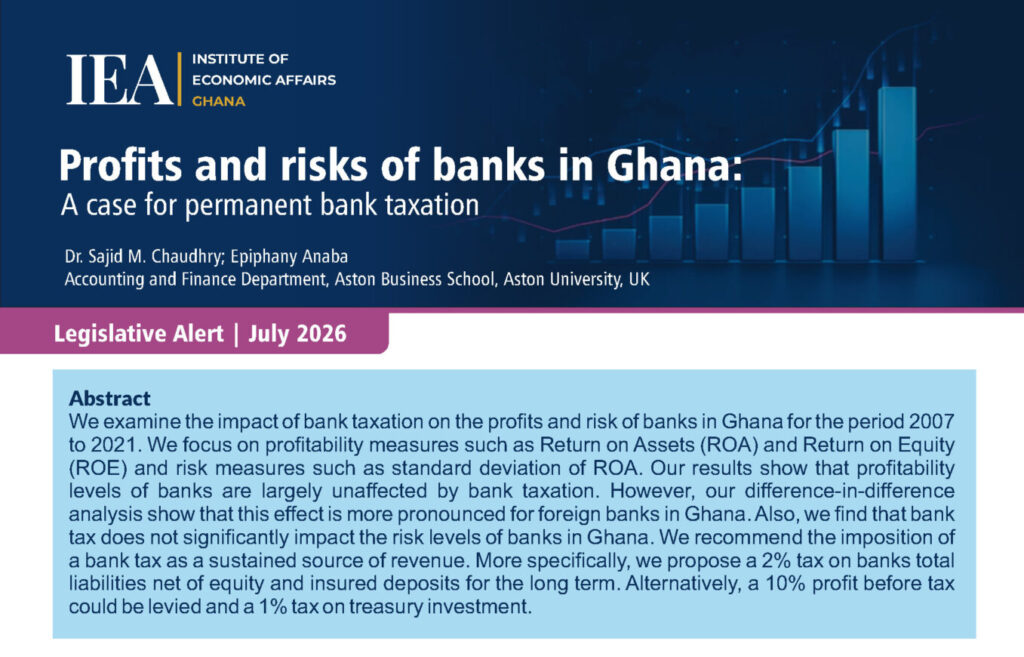
Authored by Dr. Sajid M. Chaudhry and Epiphany Anaba of Aston Business School, Aston University, UK, the publication provides an empirical assessment of the effects of bank taxation on Ghana’s banking industry between 2007 and 2021. It explores whether taxation significantly affects bank profitability and risk-taking behaviour and considers the potential for a permanent bank taxation framework to provide sustainable government revenue.
The study comes against the broader background of growing interest in financial-sector taxation as an instrument for strengthening public finances, promoting financial stability and supporting national development.
Key Findings
Using financial performance indicators, including Return on Assets (ROA), Return on Equity (ROE) and measures of banking risk, the study evaluates the effects of Ghana’s National Fiscal Stabilisation Levy (NFSL) on the banking sector.
The analysis finds that bank taxation has not significantly affected the overall risk levels of Ghanaian banks. While the study’s broad findings characterise the profitability effects as limited, its comparative regression analysis also identifies significant differences in profitability outcomes, particularly among Ghanaian and foreign banks.
The publication additionally examines banking-sector performance in Ghana relative to Nigeria, Kenya, Angola and Côte d’Ivoire. Its findings highlight Ghana’s comparatively high and volatile net interest margins, alongside evidence of relative stability in the banking industry.
These findings contribute to understanding the relationship between bank taxation, financial-sector performance and the Government’s capacity to mobilise additional domestic revenue.
Policy Recommendations
The Legislative Alert advocates the introduction of a permanent bank taxation framework as part of Ghana’s broader fiscal and financial-sector policy architecture.
The authors propose a 2% tax on banks’ total liabilities, net of equity and insured deposits, particularly targeting larger banking institutions. This approach is intended to establish a sustainable revenue source while encouraging banks to reduce excessive dependence on short-term funding.
As alternative taxation measures, the publication considers a levy on bank profits before tax and a 1% tax on treasury investments. Its analysis estimates that a 5% levy on the pre-tax profits of Ghana’s ten largest banks could generate approximately GH¢264 million, while a 1% tax on treasury securities could yield approximately GH¢577 million, based on historical financial data.
Beyond taxation, the authors emphasise the importance of complementary banking regulations, including measures addressing interest rates on deposits and loans, to support financial stability and responsible banking practices.
Significance for Ghana’s Economic Policy
The publication contributes to the national conversation on fiscal sustainability, domestic resource mobilisation and the appropriate taxation of Ghana’s financial sector.
At a time when sustainable public revenue remains central to economic development, the study presents bank taxation as a policy option deserving consideration within Ghana’s broader tax reform agenda.
It also underscores the importance of balancing revenue mobilisation objectives with the need to preserve banking-sector stability, financial intermediation and sustainable economic growth.
Through this Legislative Alert, the IEA provides research-based policy recommendations to inform public discussion and decision-making on Ghana’s taxation and financial-sector regulatory frameworks.
Read the full publication for the detailed empirical analysis, comparative banking-sector evidence, proposed taxation mechanisms and policy recommendations.