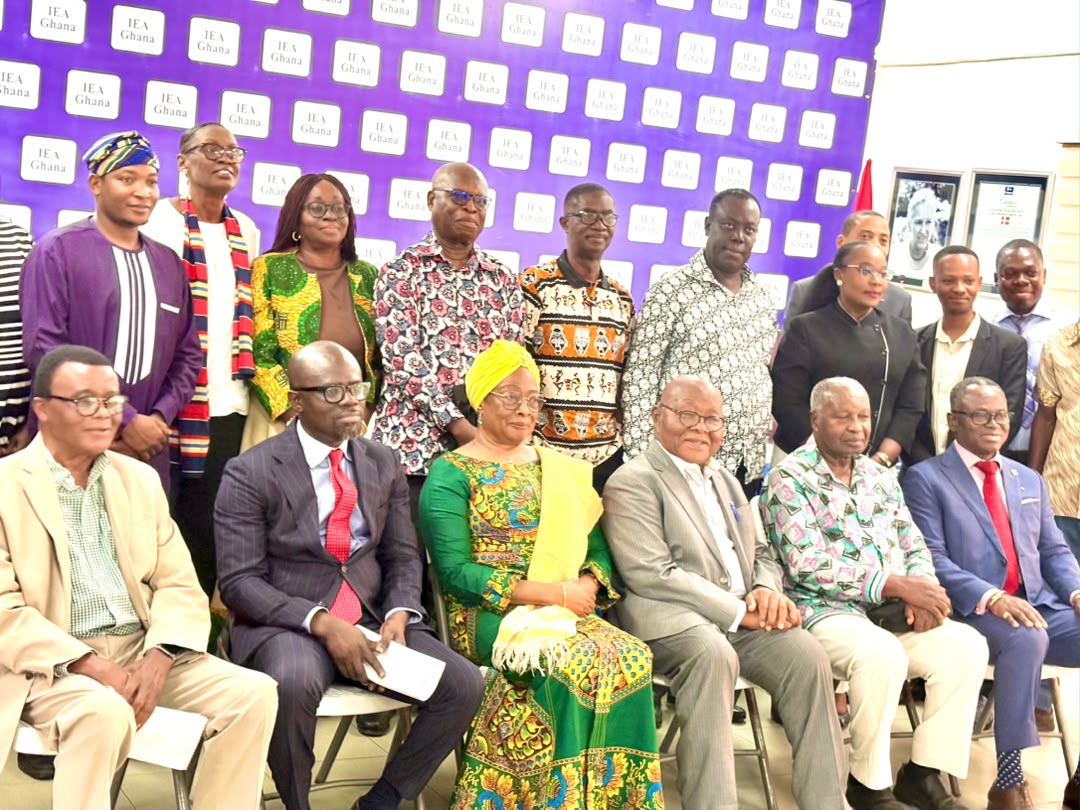
The Institute of Economic Affairs (IEA Ghana) on Tuesday, 6 October 2026, continued its Views and Reflections Programme with a high-level dialogue on the report of the Constitution Review Committee and Government’s position on Ghana’s constitutional reform process.
Held at the IEA Dialogue Centre in Accra, the programme brought together distinguished personalities with extensive experience in Parliament, governance, public policy, law and constitutional affairs to contribute to the national discussion on the future of Ghana’s democratic and governance architecture.
The session featured Rt. Hon. Prof. Aaron Mike Oquaye, former Speaker of Parliament and Distinguished Fellow of the IEA; Prof. Baffour Agyeman-Duah, Chief Executive Officer of the John A. Kufuor Foundation; and Prof. Ernest Kofi Abotsi, Dean of the School of Law at the University of Professional Studies, Accra.
The engagement formed part of the IEA’s wider effort to facilitate an informed, inclusive and non-partisan national conversation around the recommendations of the Constitution Review Committee chaired by Professor H. Kwasi Prempeh and Government’s subsequent position on the proposed reforms.
Reflecting on More Than Three Decades of Constitutional Governance
The dialogue provided an opportunity for participants to examine Ghana’s experience under the 1992 Constitution and consider some of the broader institutional and governance questions raised by the current constitutional review process.
For more than three decades, the 1992 Constitution has provided the framework for Ghana’s Fourth Republic and the country’s longest period of uninterrupted constitutional democratic government.
At the same time, practical experience with the Constitution has generated continuing debate about the distribution and exercise of political power, institutional accountability, the relationship between the Executive and Parliament, the effectiveness of independent constitutional bodies, public sector governance and the mechanisms available for citizens to hold public institutions accountable.
The current constitutional review process therefore provides an important opportunity not only to consider individual amendments but also to reflect on how Ghana’s governance institutions have functioned in practice and what reforms may be necessary to strengthen democratic accountability and institutional effectiveness.
Bringing Experience and Scholarship into the Conversation
The participation of Rt. Hon. Prof. Aaron Mike Oquaye brought to the dialogue the perspective of a constitutional scholar and an individual with extensive experience at the highest level of Ghana’s legislature.
His background in parliamentary leadership, constitutional studies and public service provided an important basis for examining the relationship between constitutional principles and the practical operation of democratic institutions.
Prof. Baffour Agyeman-Duah brought extensive experience in governance, democracy and public policy to the discussion. His participation reinforced the importance of evaluating constitutional reform not simply as a legal exercise but also in terms of how institutional arrangements affect political behaviour, democratic development and the effectiveness of the state.
Prof. Ernest Kofi Abotsi contributed the perspective of legal and constitutional scholarship, helping to situate the constitutional reform debate within the broader principles of constitutionalism, institutional design, accountability and the rule of law.
The diversity of experience represented by the speakers reflected the IEA’s objective of ensuring that Ghana’s constitutional review process benefits from serious intellectual engagement as well as practical experience of the institutions established under the Constitution.
Beyond Constitutional Amendments
A central consideration underlying the IEA’s Views and Reflections initiative is that constitutional reform should not be reduced to a catalogue of proposed amendments.
The constitutional review process also presents an opportunity to consider the quality of Ghana’s democratic institutions, the effectiveness of checks and balances, the relationship between constitutional rules and political practice, and the extent to which existing governance arrangements support accountable and effective government.
Some challenges associated with democratic governance may require constitutional change, while others may depend on stronger institutions, improved political practices, effective implementation of existing laws or changes in the broader political culture.
Creating space for these distinctions to be examined is therefore important to ensuring that the constitutional review exercise produces reforms capable of addressing the substantive governance challenges facing the country.
Promoting Broad National Ownership
The IEA continues to emphasise the importance of broad stakeholder participation in the constitutional review process.
The Constitution is the foundational framework governing the relationship between citizens and the state. Changes to that framework must consequently command more than political or institutional approval. They require public understanding, meaningful consultation and, ultimately, national legitimacy.
Through successive editions of the Views and Reflections Programme, the Institute is bringing together different constituencies to examine the recommendations of the Prempeh Committee and Government’s response from their respective perspectives.
The October 6 engagement with governance, parliamentary and legal experts followed earlier engagements involving other stakeholder groups, further broadening the range of voices contributing to the national discussion.
IEA’s Continuing Role
The Institute of Economic Affairs remains committed to supporting Ghana’s constitutional reform process through independent research, public education and structured stakeholder dialogue.
As the country considers the next stages of the constitutional review process, the IEA will continue to provide platforms through which competing ideas can be examined, areas of consensus identified and matters requiring further national deliberation brought into sharper focus.
The Institute believes that the quality of the process through which constitutional reforms are developed will be as important as the reforms themselves.
Through the Views and Reflections Programme, the IEA will therefore continue to encourage a constitutional reform process that is informed, inclusive, transparent and firmly grounded in Ghana’s long-term democratic and developmental interests.